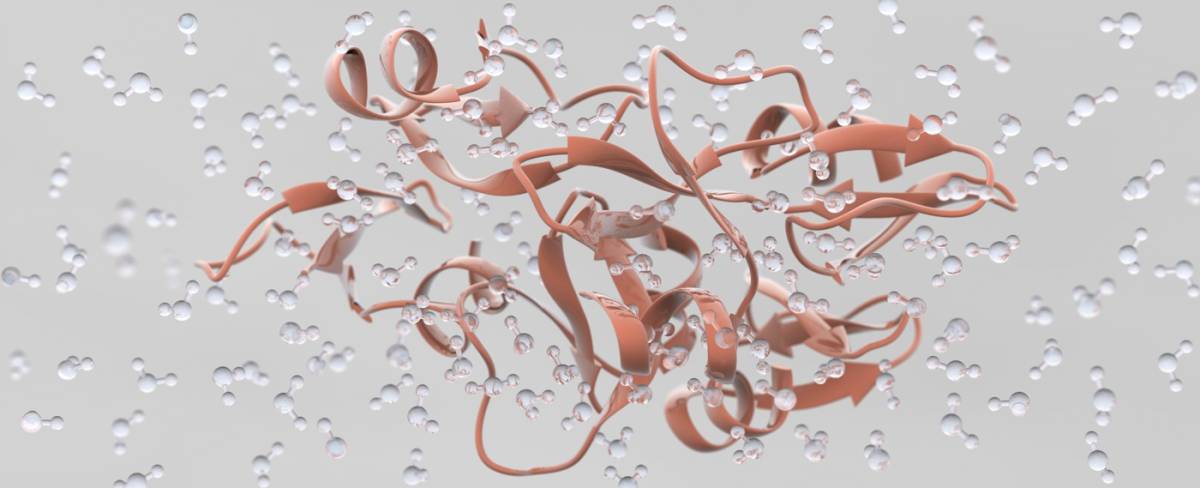
A revolutionary discipline for the study of the infinitely small
Molecular modeling is based on knowledge of atoms and their position. These data are obtained either experimentally or via public databases containing structural information. If the latter are not available, predictive homology approaches can be used to generate structures.
Nevertheless, whether experimental or theoretical, the information collected corresponds to a fixed image of the molecule at a precise moment and in a specific configuration. And yet, whatever their nature, the atoms making up molecules are endowed with movements (vibration, rotation, etc.).
The advantage of molecular modeling lies in the fact that it enables the visualization of molecules in 3D, taking into account their dynamics in space.
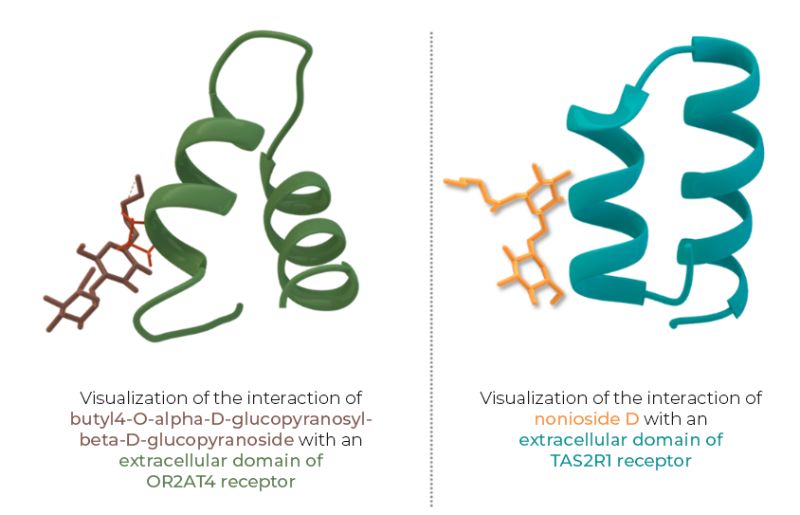
Among the various approaches to molecular modeling, docking is a commonly used term. It enables the prediction of interactions, based on the analysis of distances between two molecules. As part of the development of SENSORIALINE®, an active ingredient obtained from coconut flour, SILAB used molecular docking coupled with mass spectrometry.
This approach identified two glycolipids present in the active ingredient and capable of interacting with the olfactory and gustatory receptors OR2AT4 and TAS2R1 to promote epidermal regeneration.
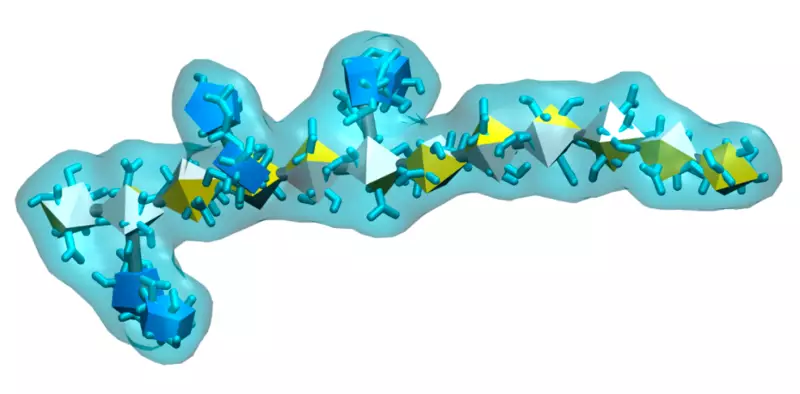
Molecular modeling also allows to define the intrinsic properties of molecules by studying them in their environment. In this context, SILAB investigated the hygroscopic potential (i.e. the ability to bind water molecules) of apiogalacturonans, an ancestral type of pectin found in the duckweed Spirodela polyrhiza.
As this sugar is not available in databases, its structure was reconstructed using quantum chemical approaches. The dynamics of this molecule were then visualized in a virtual water box, and the interaction of water molecules with the apiogalacturonan molecule was quantified.
This original approach highlighted the hygroscopic potential of apiogalacturonan, twice as high as a hyaluronic acid molecule of similar size.
Molecular modeling is therefore a cross-disciplinary field, at the frontier between biology, chemistry and computer science, enabling the prediction of biological phenomena. Applications based on this approach are numerous, and current technological advances suggest a rich future, particularly in the cosmetics or dermo-cosmetics fields.